Time & Training
What I Cut From My Training When the Week Went Long

Quick takeaways
- When the week goes long, I cut volume and extras on purpose — not the habit.
- Finishers, new programs, and makeup sessions are the first things off the card.
- I will not steal sleep or time at the door to pay a training debt at 9 p.m.
Affiliate disclosure. This post may contain affiliate links. As an Amazon Associate I earn from qualifying purchases. See the full disclosure.
Some weeks the plan I wrote on Sunday is still standing on Friday. Most weeks it is not. A line goes down later than it should. A meeting slides past the time I meant to leave. The baby has a rough night, or the kids are with me and bedtime takes the last quiet hour I had reserved for myself. By Wednesday I am looking at a training week that no longer fits the life it was supposed to live in.
I used to handle that badly in one of two ways. I would keep the original plan anyway — same sets, same “finisher,” same idea that a long week was a test of character — and I would train sloppy, get to work tight on time, or walk around irritated. Or I would scrap the week, tell myself I would start over on Monday, and do nothing. Neither version made me easier to live with, and neither one kept the habit alive.
What I do now is cut the plan on purpose. I decide, in advance, what comes off first when the week goes long, and I protect a smaller session I can still finish. It is not a complete program, and it is not a way to “make up” missed work. It is how I stay in contact with training without stealing sleep or turning the evening into a second shift.
What “a long week” actually means
I do not mean a dramatic emergency. I mean the ordinary pile-up of a long day at the plant and a house that does not run on a gym’s schedule: leaving later or getting home later more than two days in a row, short sleep because a child was up, evenings that belong to dinner and the door when the kids are with me, a Saturday I had counted on for a longer session, or leftover work still in my head after I have left the floor.
None of that is a moral failure. It is the week. The mistake is pretending the Sunday plan still applies and then treating myself as if I failed the plan. The plan is the thing that should yield. I also do not use a long week as a story about the other house, or as a reason to keep score about who has the harder stretch. Two houses have two schedules. Mine still has to fit inside the hours I actually have.
The rule I use when I have to cut
I cut volume, novelty, and anything that makes the session longer than the clock I still have. I do not cut the idea of showing up, even if “showing up” is a 12-minute circuit or a walk down the street.
The Physical Activity Guidelines for Americans, as summarized by the CDC, call for at least 150 minutes of moderate-intensity activity a week, or 75 minutes of vigorous activity, or an equivalent mix, plus muscle-strengthening work on two or more days. The same page says you can spread activity through the week and break it into smaller chunks, and that some physical activity is better than none.
I say that carefully, because a cut week at my house does not always add up to 150 minutes or two strength days. I will not dress a short garage session up as if it met the guideline. I use the guideline so I do not panic when a week shrinks, and so I do not throw away a short session as if it counted for nothing.
The personal rule is simple. I keep a short, known session I can finish without rushing the door. I drop extra sets, isolation work, and any new movement I have not already practiced. I do not steal sleep or family time to “pay back” what I missed. If something feels sharp or wrong, I stop. That last one is not a training theory. I am not a clinician, and I do not work through a sharp pain in the garage because the calendar looks ugly.
What I cut first
Finishers go first. The last circuit, the long carry, the “one more” set after the timer — those are the minutes that make me late, too sweaty for the time I have to get clean, or too cooked for the rest of the morning. On a normal week I sometimes like that work. On a long week it is the first thing I take off the card.
New programs go next. A long week is a bad time to start a plan I saw the night before or add a lift I have not done in months. I stay with movements I already know: a squat or sit-to-stand, a hinge, a row, a push, and a carry if there is time.
Makeup sessions go too. If I missed Monday and Tuesday, I do not do a doubled session on Wednesday night after the kids are down. That is how I also miss sleep, and sleep already has enough competition here. A missed day is missed. I can walk at lunch. I can do the short version tomorrow.
The long Saturday is not guaranteed. I like a longer session when there is a real window after breakfast. I do not protect it by being short with anyone in the house, and I do not try to recover a full family Saturday in the garage at 9 p.m.
I also cut the private scoreboard. I used to keep a note of sets I “owed” the week. It made every short session feel like a debt payment, so I threw it away. The record I care about now is whether I did something I could repeat.
What I keep
| Version | What it is | When I use it |
|---|---|---|
| 20 minutes | The usual garage circuit, hard stop on the timer | I slept reasonably and I can still leave on time |
| 12 minutes | One hinge, squat, push, and row; no finisher | The week is already leaning |
| 8 minutes | A brisk walk down the street and back | Sleep was short, or the garage would wake the house |
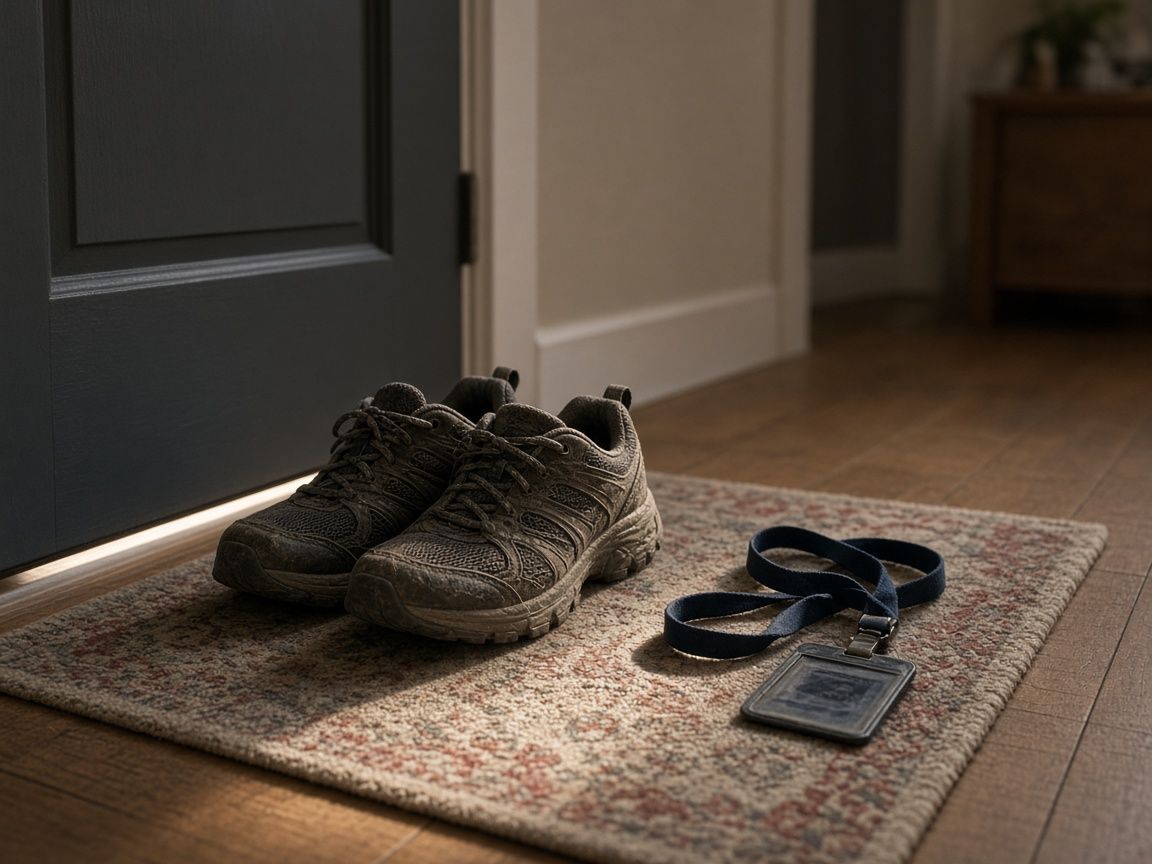
I keep a version of the same 20-minute garage session I already wrote about, and two shorter versions on the wall so I am not inventing a plan at 5:40 a.m. The 20-minute version stays if I slept reasonably and I can still leave on time. The 12-minute version is the one I use most on a long week: one hinge, one squat, one push, one row, a couple of controlled sets each, no finisher, and no carry if the clock is already tight. The 8-minute version is a brisk walk down the street and back, in shoes I left by the door the night before. If I cannot open the garage without waking the house, I take the walk.
I try, when I can, to keep two days with some muscle-strengthening work, because that is the part of the guideline I miss first when I only walk. Some long weeks I get one strength day and a few walks. I treat that as the week I actually had, not as a license to do nothing and not as a full week of training.
I also keep the night-before setup, even when I know I will probably use the short version. Shoes out. Water bottle filled. The card on the wall already decided.
How I decide in the middle of the week

I used to wait until I felt overwhelmed, then cut everything. That was late. I now make the cut as soon as I can see the week leaning. If Monday already ran long and Tuesday looks the same, I switch to the 12-minute card that night. If a child was up and I can feel I am not safe under a heavy hinge, I walk. If I get home late and the kids are with me, I do not disappear into the garage while everyone else is in the kitchen. The session can move to tomorrow’s short version, become a walk at lunch, or be skipped.
Lunch walks have saved more weeks than I expected. I cannot always take a full 30 minutes. I can often take 15 if I leave the break room without my phone stuck on work email. The CDC page I already cited is why I stopped treating that loop as a consolation prize. I just stop forcing a session into a gap that is not there.
What I will not cut to save the plan
I will not cut sleep to keep a training streak. A 5:20 a.m. alarm after a short night is how I show up dull at a 7 a.m. start, and the plant does not need that version of me.
I will not cut the time at the door when the kids are coming or going. The handoff is not a training slot. If the evening is already tight, the garage can wait.
I will not cut basic decency toward the people in this house, or toward the other house, to protect a workout. Being on time, being civil, and handing off what someone needs to know — those are not extras I drop so I can get a third set of rows.
And I will not cut the stop rule. If a movement feels sharp, I put it down. A long week is not an excuse to be reckless with a body I need for work tomorrow.
What a cut week is not
It is not a challenge, a punishment for a hard week at work, or a way to earn a quieter weekend. It is also not medical advice. I cannot tell you how much activity you need, how to come back from an injury, or whether a short night means you should train or rest. If you have a condition that makes hard exercise a bad idea, or if you are not sure, that is a question for your own clinician. I can only tell you what I drop when my week gets long, and what I refuse to drop with it.
The useful surprise was that cutting on purpose made me more consistent, not less. The week still goes long. I still miss days. I still look at the Sunday plan and laugh. But I am no longer waiting for a clean week to become a person who trains. I have a smaller session, a shorter one, and a walk, and I pick from those instead of from my own frustration. When the week opens up again, I can add a set, bring back a carry, or take a longer Saturday if it is actually available. I do not owe the long week a debt first. I just start from the version that still fits.
Sources
- Centers for Disease Control and Prevention, “Adult Activity: An Overview” (Physical Activity Guidelines for Americans: at least 150 minutes of moderate-intensity activity a week, or 75 minutes of vigorous activity, or an equivalent mix; muscle-strengthening activity on two or more days; some activity is better than none): cdc.gov/physical-activity-basics/guidelines/adults.html
Gear I actually use
- The same timer I use on a normal morningThe short versions still need a hard stop.
- Walking shoes I leave by the doorThe 8-minute version should not start with a scavenger hunt.
Product links will appear here when they are live. No affiliate links in this box yet.
Medical disclaimer. This is personal experience, not medical advice, and it is not a substitute for care from a qualified professional. Talk with your own clinician before changing how you eat, train, fast, or sleep, especially if you have a medical condition, take medication, are pregnant, or are feeding a baby. Read the full medical disclaimer.