Keto & IF
Intermittent Fasting on a 7-to-5 (or Later) Schedule Without Skipping Family Dinner
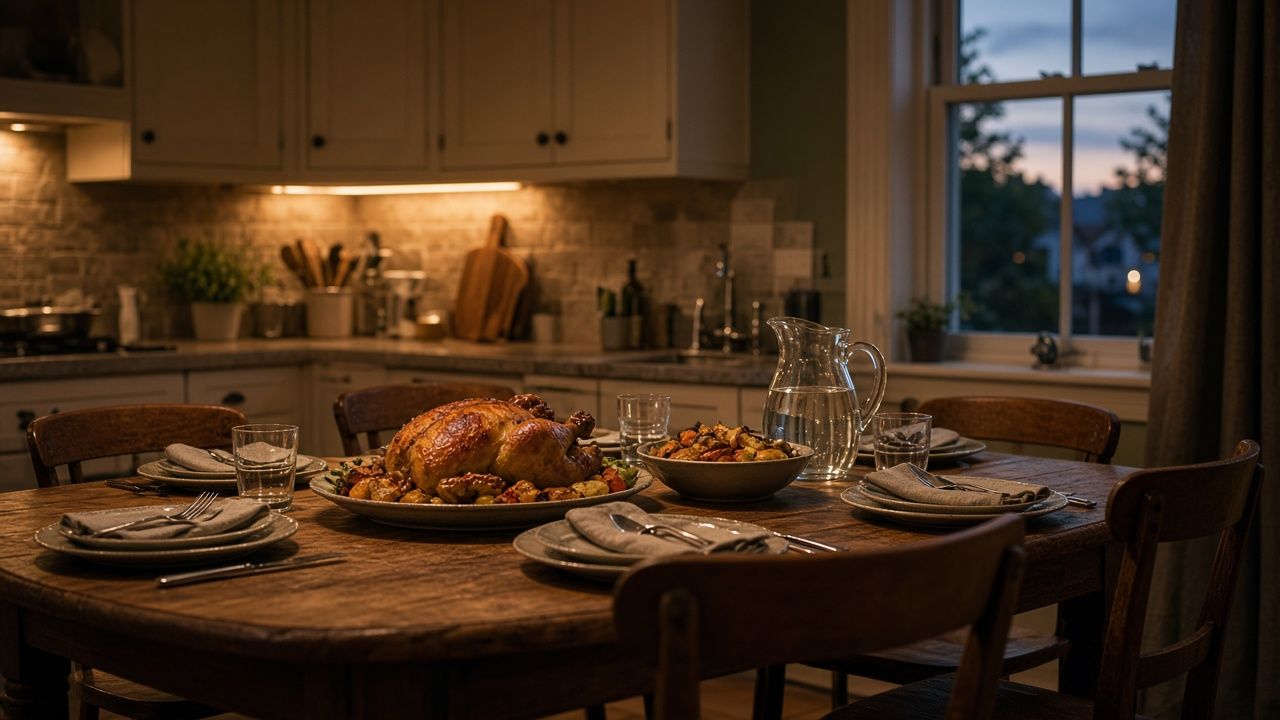
Quick takeaways
- The window is built around family dinner, not the other way around.
- If dinner is late, I move the window rather than skip the table.
- This is what I do, not a prescription, and fasting is not automatically safe for everyone.
Affiliate disclosure. This post may contain affiliate links. As an Amazon Associate I earn from qualifying purchases. See the full disclosure.
I did not start eating in a daily window because I wanted a project. I started because breakfast at 5:30 a.m. was a rushed plate I barely tasted, followed by a mid-morning hunt for something else, followed by a lunch that depended on whatever was left in the break room. By dinner I was either starving and short-tempered or already snacking in the car. None of that was a plan. It was just a long day with no edges.
What I do now is simpler to describe than it was to settle into: I eat in a set window later in the day, and I make sure that window includes family dinner. I am not offering this as a medical plan. The National Institute on Aging has said there is not enough evidence to recommend calorie-restriction or fasting diets to the public, and that anyone considering a big change in eating pattern should talk with a healthcare provider about benefits and risks. I agree with that caution. This post is only about the logistics of the way I eat on a 7-to-5 schedule, and how I keep dinner with the people in my house on the calendar instead of on the chopping block.
The constraint that actually matters
A lot of intermittent-fasting talk assumes you can place the window wherever it is convenient: skip dinner, eat at 10 a.m., train at noon, and close the kitchen at 6. That is not my life.
I start work around 7 a.m. I cannot move that. Dinner is the one meal I can count on sharing with my wife and, on the nights the kids are with us, with them. I will not build an eating pattern that turns me into the person who sits at the table with a black coffee and a lecture. If the window cannot include dinner, the window is the wrong tool.
So the window I use is a late-morning or midday start and an evening close, after dinner and a little time to clean up. On a clean weekday that might look like eating between late morning and early evening. I am deliberately not treating the clock times as a prescription. The principle is the part I can defend: the workday can start without a plate, and the day still ends with a meal at the table.
Mornings at the plant
I used to believe I could not function until I had eaten. What I actually needed in the first hours was water, a realistic sense of the day’s meetings, and a hard stop on the pastry that appears in a break room and disappears into my morning without me deciding it.

On this schedule, my morning looks like this:
- Water when I wake up, and more water when I get to work
- Coffee if I want it, without turning it into a sweet drink that is secretly breakfast
- A planned first meal at a time I can actually take, not a time I invented in a burst of optimism
I keep the first meal simple and already packed, because a “I’ll go out and find something” plan fails when a morning meeting runs long. If the first meal is a container from the night before, I can eat it in a short break and get back to the floor or the office without a 40-minute errand.
I also had to be honest about hunger. Early hunger is sometimes just habit or thirst. Sometimes it is real, and I am not interested in turning this into a willpower contest. If I sleep poorly, if I trained hard, or if I feel unwell, I eat. The point of a window is to give the day a shape, not to win a streak on an app.
How dinner stays inside the window
Dinner is the anchor. I work backward from it.
If dinner is at a normal family hour, I need the window to still be open. If I start eating too early — a big first meal at 9 a.m. plus an early lunch — I find myself “closing” the window before the kids are even at the table, and then I am bargaining. Bargaining is how I end up eating a second dinner in the kitchen at 9:30, which is the old problem with extra steps.
So I keep the first meal later than my old breakfast, and I keep lunch moderate enough that dinner is still a real meal, not a formality. I try to eat protein and vegetables I already have in the fridge. I do not need dinner to be a performance. I need it to be a meal I can sit through as a person who is present, not as a person watching the clock.
When the kids are with us, dinner has a noise and a pace I cannot control, and I do not try to. The window is mine. The table is ours. If a child is eating pasta or a roll, I do not narrate my plate. I eat what I packed or cooked for myself, I keep the tone ordinary, and I let the meal be a meal. The post I would rather write is about packing lunches at 9 p.m., not about turning a child’s plate into a conversation they did not ask for.
When the day runs past 5
Some days I am not leaving at 5. A line issue, a meeting, a late call — the plant does not always respect my preferred window. This is the part of “intermittent fasting for busy people” that often gets skipped.
I have three rules for late days, and they are boring on purpose:
- Dinner with my family still happens if I can be there. If I will miss the table, I say so early, not from the parking lot at 7:15.
- I do not “make up for” a late night by skipping the next day’s first meal to keep some average. I just start again the next morning.
- If I get home after dinner, I eat a plate that was held back for me, or I make a small version of the same food. I do not treat the late arrival as a reason to graze until midnight.
The window can shift later on a late night. I would rather have a later close and a real meal than a rigid close and a bag of whatever I can find in the pantry while I stand at the counter. Rigidity is what makes people quit. I already have a rigid start time at work. I do not need two.
What I do not claim
I do not claim this eating pattern treats a disease, “resets” a metabolism, or is the reason for any particular number on a scale. I do not know how it would land for you. I especially would not try to map this onto someone who is pregnant, someone who is breastfeeding, someone who takes medication that affects blood sugar, someone with a history of disordered eating, or someone whose clinician has already given them a different meal schedule.
I also do not fast on days when I am sick, and I do not use a window to skip water. I do not train hard in the garage and then brag about not eating until late afternoon if I feel shaky or off. That is not discipline. That is me ignoring a signal I should not ignore.
If you are curious about fasting diets in general, read the National Institute on Aging overview I cite below and talk with your own clinician before you change anything. If you want the logistics of a long workday, the useful part is the one I had to learn the slow way: put family dinner in the window first, then arrange the rest of the day around the work start you cannot move.
A weekday that actually held
A weekday that works looks like this. I get up, drink water, and leave on time. I do not eat in the car. Midday, I eat the meal I packed. I drink water through the afternoon. I come home, I wash my hands, I help get dinner on the table, and I sit down. After dishes, the window closes. I can still have tea or water in the evening. I can still sit on the floor and play. I am not “done with the day” because I am done eating. I am just done negotiating with the pantry.
A weekday that does not work looks like a late meeting, a skipped packed meal, a gas-station snack I did not plan, and a dinner I barely taste because I am still catching up. When that happens, I do not write a new set of rules at 10 p.m. I pack the next day’s food, I set the next day’s clothes, and I go to bed.
The long day already has enough moving parts. The eating window is only useful if it removes a few of them.
Sources
- National Institute on Aging, “Calorie restriction and fasting diets: What do we know?” (describes time-restricted eating and other fasting patterns; states there is insufficient evidence to recommend these regimens to the public; advises speaking with a healthcare provider before making a significant change): nia.nih.gov/news/calorie-restriction-and-fasting-diets-what-do-we-know
Medical disclaimer. This is personal experience, not medical advice, and it is not a substitute for care from a qualified professional. Talk with your own clinician before changing how you eat, train, fast, or sleep, especially if you have a medical condition, take medication, are pregnant, or are feeding a baby. Read the full medical disclaimer.