Time & Training
A 20-Minute Garage Workout I Can Finish Before a 7 AM Start
Quick takeaways
- The useful work happens the night before: shoes out, a clear rectangle, and a session already decided.
- I set one 20-minute timer and stop when it ends, even if a set is left.
- A 12-minute circuit or an 8-minute walk still counts when the morning is tight.
- A short session is a piece of a week, not a complete fitness program.
Affiliate disclosure. This post may contain affiliate links. As an Amazon Associate I earn from qualifying purchases. See the full disclosure.
I used to treat training like a second job I kept failing. If I could not get 45 minutes, a full warm-up, and a shower that did not feel rushed, I skipped the morning and told myself I would go after work. After work is when the kids, the inbox leftovers, and a tired version of me show up. The session did not happen.
What I have now is smaller and less impressive. It is a 20-minute session in the garage that I can finish before I leave for a 7 a.m. start. It is not a complete fitness program, and I do not pretend it is. The Physical Activity Guidelines for Americans, as summarized by the CDC, call for at least 150 minutes of moderate-intensity activity a week, or 75 minutes of vigorous activity, plus muscle-strengthening work on two or more days. A 20-minute garage block is a piece of that, not the whole thing. Some weeks I add a walk at lunch or a Saturday session. Some weeks this is what I get, and I would rather keep the habit than wait for a perfect morning.
This is what the morning actually looks like, how I keep it to 20 minutes, and what I cut when the clock is tight.
The night-before setup is the workout
If I have to hunt for shoes at 5:40 a.m., I am already late. The useful work happens the night before, usually after the kids are down and I am already in the kitchen packing lunch.
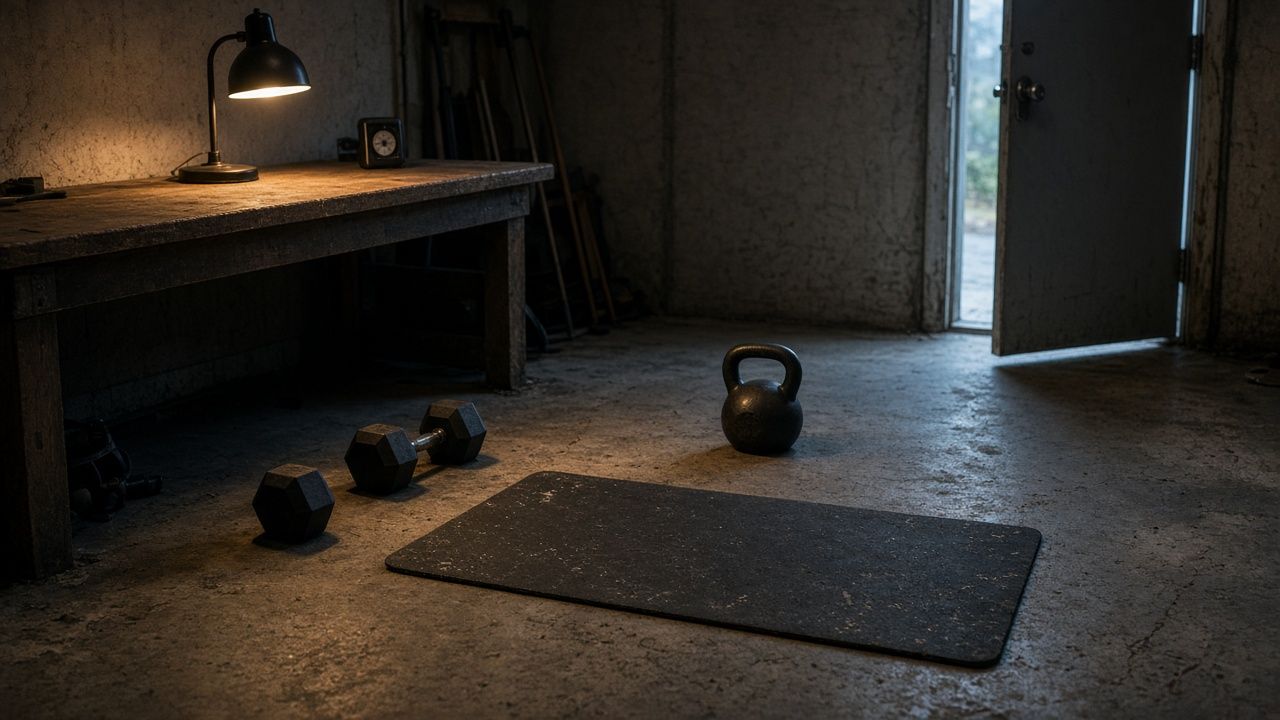
I leave a clear rectangle on the garage floor. Not a full gym — a space I can step into without moving a stroller or a storage bin. I set out the pair of dumbbells I will use, a kettlebell if that is the day’s tool, and a mat. I fill a water bottle and leave it on the workbench. The clothes I will train in sit in one stack: shorts, shirt, socks, shoes. I charge the phone in the kitchen, not in my hand in the garage, because the phone is how I wander out of the 20 minutes.
I also decide the session in advance. “I’ll see how I feel” is how I lose the first five minutes to browsing a plan. I keep a short menu of sessions I already know, written on a card on the wall:
- Lower-body hinge and squat pattern
- Upper-body push and pull
- A mixed full-body circuit
- A walk-and-carry day when I am sore or short on sleep
I pick one of those four the night before and I do not renegotiate it in the dark.
The clock I actually use
I need to walk out the door with enough time to get to the plant, through the lot, and in place before 7. That means the session has a hard stop, not a hopeful one. I work backward:
- Out the door at a fixed time
- Ten minutes to towel off, get into work clothes, and grab the bag I packed the night before
- Twenty minutes of training
- A few minutes to walk into the garage and start the timer
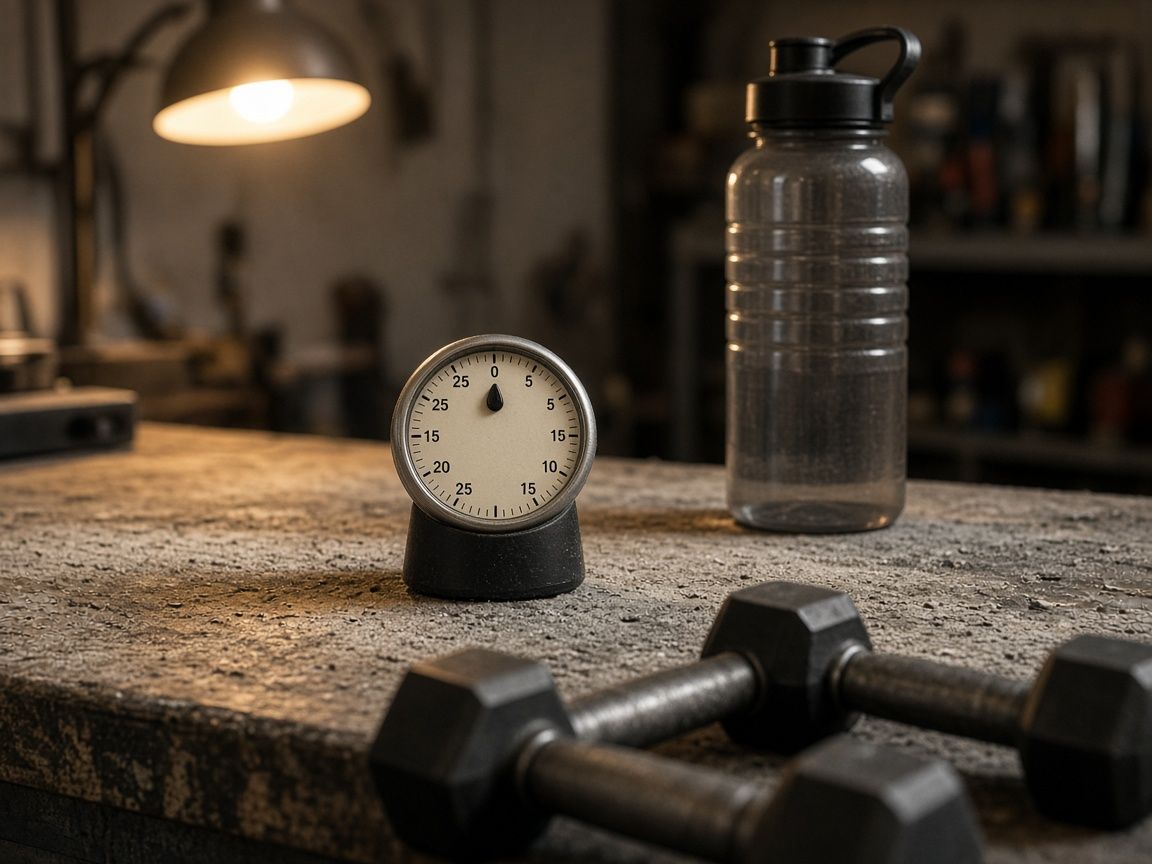
I set one timer for 20 minutes when my hands are on the first implement. When it ends, I stop, even if I had one set left. Leaving a set in the tank is annoying. Being late to a 7 a.m. start is worse, and it is how this whole idea gets quietly retired.
I do not do a long mobility flow. I do two minutes of the same easy pattern every time: a slow march in place, a few bodyweight squats, shoulder circles, and one light set of whatever the first movement is. That is the warm-up. If something feels sharp or wrong, I stop and switch to an easy walk around the block or I skip the session. I do not try to “work through” a sharp pain in a cold garage before dawn. I am not a clinician, and this is not a rehab plan.
A session that fits a small floor
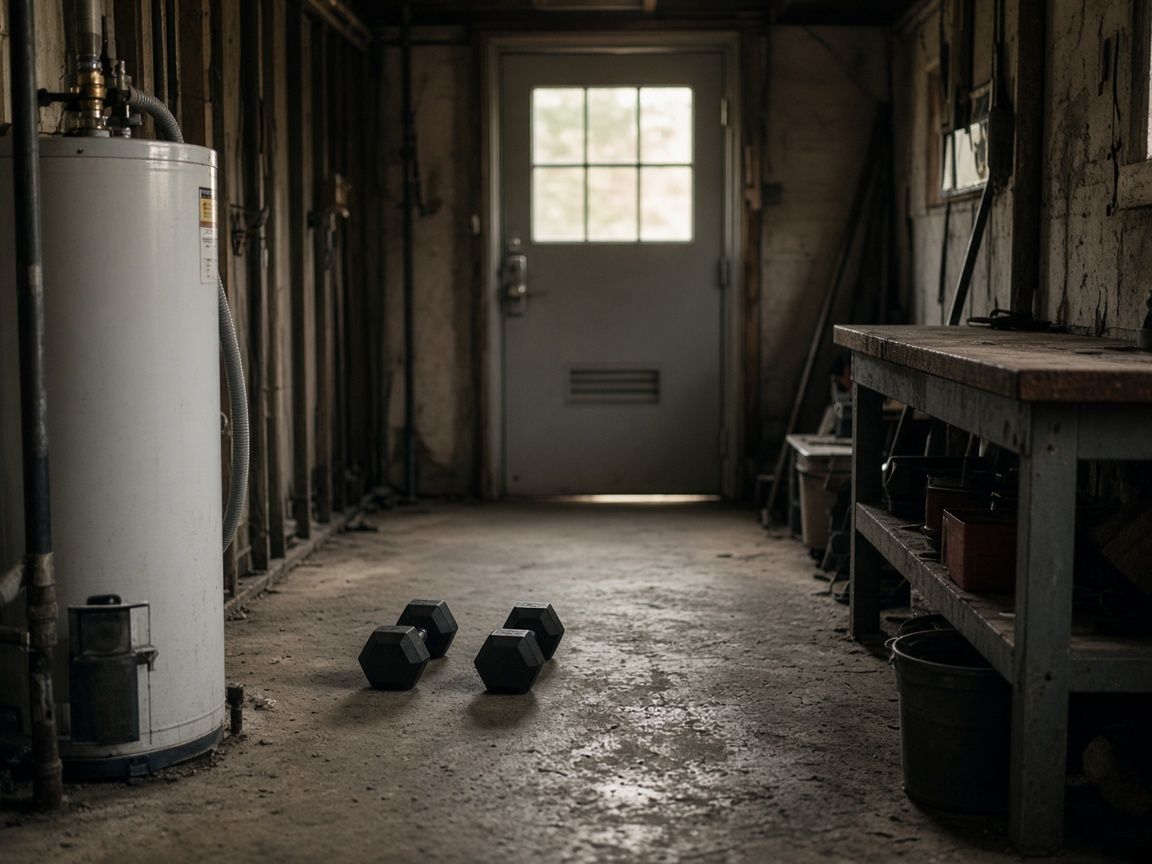
The garage is not a gym. The ceiling is low enough that jumping around feels foolish, and I do not want to drop a weight at 5:50 a.m. and wake the house. So the work is quiet, simple, and mostly in place.
A typical full-body morning looks like a circuit I can repeat for the remaining time:
- A squat or sit-to-stand from a box, or a goblet squat if the dumbbell is ready
- A hinge: a Romanian deadlift with the dumbbells, or a kettlebell deadlift from the floor
- A row: a bent-over row with the same dumbbells, or a backpack row if I want less noise
- A push: a push-up with my hands on the mat, or an elevated push-up on the bench if I need to keep it quieter and more controlled
- A carry: a farmer carry up and down the length of the garage, turning carefully around the water heater
I choose a load I can move with a clean position for the whole 20 minutes, not a load that turns the last round into a mess. I rest just enough to keep the next set tidy. I am not chasing a record. I am getting a training stimulus I can repeat tomorrow.
On an upper-body morning I bias the push and pull and keep a simple lower-body pattern in the mix so I do not skip legs for a week. On a lower-body morning I keep one row or push-up so the session still feels like I showed up as a whole person, not as a pair of knees.
The carry is my favorite piece because it is honest. You pick the weights up, you walk, you set them down without banging the floor. It raises my breathing, it does not require a video, and it ends when the timer ends.
What I do not do at 5:45 a.m.
I do not start a new program I saw the night before. New programs are for a Saturday when I can read, set up, and not risk a sloppy first attempt in the dark.
I do not use the garage as a place to check work email. If I open the inbox, the 20 minutes becomes a standing meeting with my own anxiety, and I will not have trained.
I do not add “just one more finishing circuit.” The finishing circuit is how I get sweaty enough to need a real shower I do not have time for. I want to be warm, a little out of breath, and still able to get clean with a towel and a quick wash at the sink or a short shower if the house schedule allows. On many mornings it is a washcloth, deodorant, and work clothes. Vanity is not the point. Showing up on time is.
I also do not treat a missed morning as a debt I have to repay at 9 p.m. If I miss, I miss. I can walk at lunch. I can try again tomorrow. Turning a missed 20 minutes into a late-night workout is how I also miss sleep, and sleep already has enough competition in this house.
How this fits a week that is not tidy
Some mornings the baby was up. Some mornings I am walking out the door later because a lunch did not get packed or a bag is missing a shoe. The plan has to survive that.
I keep a 12-minute version: one hinge, one squat, one push, one row, each for a few controlled sets, no carry. I keep an 8-minute version that is just a brisk walk down the street and back, shoes I left by the door. “Some physical activity is better than none” is the line from the same CDC page I already cited, and it is the one I use when people — including me — treat a short session as if it does not count.
I also do not need the garage. If the weather is fine and I do not want to open the garage door, I take the walk. If I am traveling for work, I do a push-up and walking session in a hotel room and I do not film it.
Saturdays are different when the kids are with me. I may get a longer session after breakfast, or I may get a playground hour that is not a workout and still involves a lot of moving. I do not try to force a 5:40 a.m. garage session on a morning when a child will be up and looking for me. The weekday version exists because the weekday is the hard part.
What I needed to believe, and what I didn’t
I had to stop believing that a short session was a moral failure. I also had to stop believing that 20 minutes would magically do every kind of training I might want over a year. I still like a longer Saturday when I can have it. I still take walks. I still miss days.
What the 20-minute cap did was remove the negotiation. I know what I am doing, I know when it ends, and I know I can still start work on time. The garage is not a sanctuary. It is a rectangle of concrete with a timer on the bench. That turns out to be enough to keep me in the habit through a long season of early starts.
If you try a version of this, keep it conservative if you are coming back from a layoff, an injury, or a long stretch of poor sleep. Get a clearance from your own clinician if you have a condition that makes hard exercise a bad idea, or if you are not sure. I cannot judge that for you. I can only tell you that the session that fits my 7 a.m. start is the one I will still be doing in February, and that is the standard I use when I set the timer.
Sources
- Centers for Disease Control and Prevention, “Adult Activity: An Overview,” describing the Physical Activity Guidelines for Americans (at least 150 minutes of moderate-intensity activity a week, or 75 minutes of vigorous activity, plus muscle-strengthening activity on two or more days; some activity is better than none): cdc.gov/physical-activity-basics/guidelines/adults.html
Gear I actually use
- A simple 20-minute timerI want a hard stop I can hear without opening a phone.
- A pair of dumbbells I can keep on the floorThe load stays light enough to move quietly before 6 a.m.
- A kettlebell for hinges and carriesOne implement that does not need a lot of space.
Product links will appear here when they are live. No affiliate links in this box yet.
Medical disclaimer. This is personal experience, not medical advice, and it is not a substitute for care from a qualified professional. Talk with your own clinician before changing how you eat, train, fast, or sleep, especially if you have a medical condition, take medication, are pregnant, or are feeding a baby. Read the full medical disclaimer.